Colindar vs Playtomic for HOAs: Which One Fits?
It is one of the most common questions at owners’ meetings in Spanish developments with a padel court: “if Playtomic already exists and everyone has it installed, why would we pay for another app just for ours?”. It is a fair question, and the answer is not that one tool is better than the other. It is that they solve two different problems.
Playtomic is a well-established racket sports platform. Colindar is an app for homeowners associations. They share one word — “booking” — and very little else. This comparison sets out the differences using each product’s own public information, so your community can decide on the evidence.
What Playtomic is, according to its official information
Playtomic S.L. describes its app as the one that connects you with a community of more than one million players of padel, tennis and other racket sports. Its own description highlights:
- Finding like-minded players and partners of a similar level, with chat and progress tracking.
- Creating private or public matches at padel clubs, and joining matches already created.
- Booking a court within a wide network of clubs with more than 18,000 courts worldwide, indoor and outdoor.
- Paying the full amount or splitting the payment between players.
- Taking part in leagues, tournaments and rankings.
Alongside the player app, Playtomic offers a management product for venues, Playtomic Manager, whose plans and prices are published on its website for racket sports clubs.
In short, it is an excellent ecosystem for what it was designed to do: players looking for a game, and clubs selling court time. In the public information we were able to consult, its audience is racket sports players and clubs; we found no references to private courts inside homeowners associations.
What Colindar is
Colindar is an app for homeowners associations in Spain. It has been on the market for over 10 years, with more than 500 active communities, more than 30,000 residents using it and more than 500,000 bookings handled.
Its unit of reference is not the player: it is the property. Each home holds its own usage rights, and the rules approved at the owners’ meeting are applied automatically against that register. The padel court is one facility among several: pool, gym, function room, barbecue area, visitor parking and access gates.
The underlying difference: selling hours or sharing a resource
Everything else follows from this. A padel club has one objective: fill the court and bill for it. The more hours it sells, and to more different players, the better. It wants anyone in the city to be able to find a free slot and pay for it.
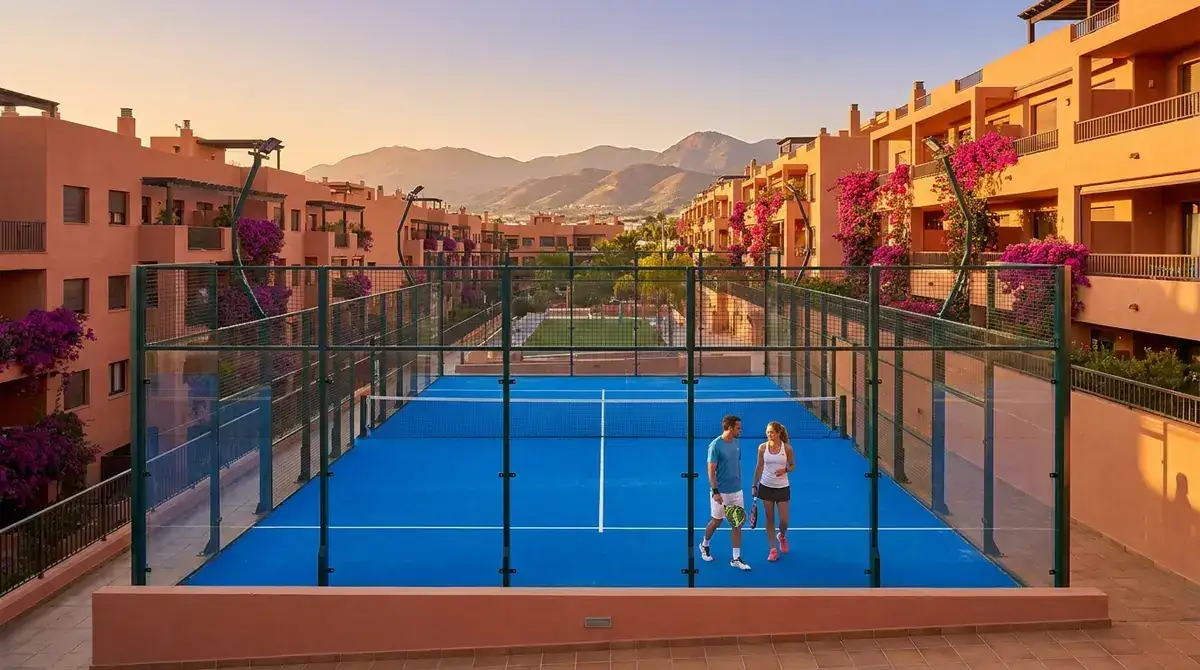
A homeowners association has the opposite objective: fairly sharing a resource that is already paid for. The court generates no revenue; it is funded by everyone’s service charges. Nobody from outside should be able to book it. And the problem is not filling it — it is stopping the same three neighbours from occupying it every week.
From that difference come requirements a club simply does not have:
- A quota per home, not per person. If one family holds four accounts, the quota must still be that of a single property.
- A limited booking window, so nobody blocks the whole month on the 1st.
- Booking tied to the community register: only registered owners and tenants.
- No mandatory payment gateway in most cases, because the court is free for the resident.
- Physical access linked to the booking, because the court usually sits inside a gated area.
Point-by-point comparison
| Colindar | Playtomic | |
|---|---|---|
| Audience it addresses | Homeowners associations in Spain | Racket sports players and clubs, per its official information |
| What the user books | Any shared facility in their own community | A court within the platform’s club network |
| Who can book | Only residents on the community register | Players registered on the platform |
| Scope beyond padel | Pool, gym, function room, barbecue area, parking | Focused on racket sports |
| Pool capacity and time slots | Yes | Not applicable to its use case |
| Opening the site’s gates | Yes, with the home automation add-on | Not publicly documented |
| Payment split between players | Not applicable: the court belongs to the community | Yes, full or split payment |
| Leagues, tournaments and rankings | No | Yes |
| Prices published on its website | Yes | Yes, for clubs (Playtomic Manager) |
When Playtomic is the right choice
In all honesty: if what you want is to play more and meet people, Playtomic is an excellent tool and there is no reason to stop using it. It makes sense when:
- You are looking for a game outside your development, at clubs around your city.
- You want to improve your level, compete in leagues or climb a ranking.
- You need a fourth player on a Tuesday evening.
- You are playing at a venue open to the public and want to split the cost.
Plenty of residents in communities that run Colindar also use a player platform for everything outside the gates. They are not mutually exclusive: one organises your sporting life, the other organises your building.
When your community needs something else
Your community needs a community app rather than a player platform when:
- The court is private and only residents may use it.
- You need to cap how many times each home books per week.
- Beyond the court there is a pool with a capacity limit, a gym or a function room.
- The site is gated and today it is opened with a key or a fob everyone has copied.
- The president wants to stop refereeing who booked first.
That is precisely the scenario Colindar’s padel court booking exists for. And if your problem is the classic one — three residents monopolising the court — we will shortly publish a dedicated article on how to stop it, with the specific rules that actually work.
The point almost nobody considers: the gate
In a residential community, booking is only half the problem. The other half is getting in. The court usually sits inside a fenced area, and that area is opened with a key, a fob or a code half the neighbourhood ends up knowing.
When the booking and the access are connected, the resident arrives on time and opens the gate with their phone; outside their slot, they do not get in. No fobs to hand out, no lock to change when somebody moves, no argument about who left the gate open. That is what the automatic door opening add-on solves, starting at €460/year per controller plus hardware.
No platform designed for clubs needs to solve this: a club has a reception desk.
What it means for the property manager and the president
This deserves to be said plainly, because it is the real objection at the meeting: nobody has to start managing anything.
The rules — quota per home, booking window, opening hours, no-show penalties — are approved once at the owners’ meeting and configured once in the app. From then on residents book by themselves and the system enforces the rules on its own. The president stops refereeing, and the property management office does not gain a single task: on the contrary, it stops taking the Saturday morning phone calls.
If your community is still comparing options more broadly, our guide to the best apps to book padel courts in your community adds context on what to look for.
What each option costs the community
Colindar publishes its prices: Basic plan €163/year for up to 50 properties and Complete plan €260/year, with a payments add-on at €132/year and home automation from €460/year per controller plus hardware. No lock-in, and a 15-day free demo with no card details.
Playtomic also publishes prices for its club product on its official website. The question is fit rather than figures: it is software for racket sports clubs, not a tool designed to share common areas fairly between the homes of a Spanish homeowners association.
FAQ
Can we list our community court on a player platform? That depends on each platform’s terms and on what the owners’ meeting decides, but it is worth thinking twice: opening the court to outside players changes its nature and tends to raise insurance, liability and neighbourly issues.
Do residents have to install two apps? Only if they want to. Colindar is for their community; a player platform is for their sporting life outside it. Most residents only need the first.
Does Colindar make sense if we only have a padel court and nothing else? Yes. The Basic plan covers a community of up to 50 properties for €163/year, and the quota and booking-window rules work the same with one facility as with six.
Can we limit the number of bookings per home? Yes, and it is the most used feature. The owners’ meeting decides the weekly quota and the system applies it without anyone having to check.
What happens if a resident books and does not show up? The community can approve a no-show penalty. The system applies it automatically to the home that made the booking.
Try it on your own court
The best way to settle this discussion at the meeting is to show the app running on your actual facilities. Try the free demo: 15 days, no card details, no lock-in.
Third-party information verified on their official websites on 8 September 2026.