Common Area Booking Software: 2026 Buyer's Guide
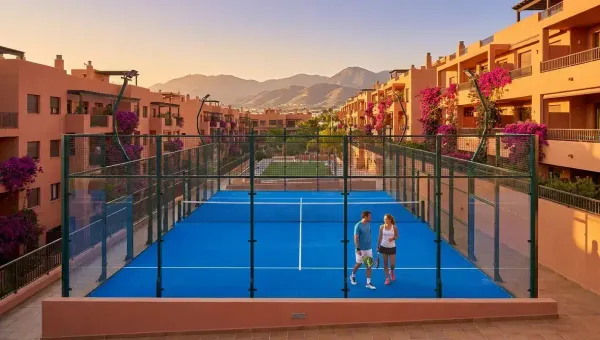
Most homeowners associations start the same way. A sheet of paper on the noticeboard, a WhatsApp group and the goodwill of whoever happens to be around. It works for a few months. Then come the double bookings, the neighbour who takes the padel court three evenings in a row, and the feeling that the shared facilities always end up with the same handful of people.
Common area booking software fixes that without turning it into a new job for anybody. This 2026 buyer’s guide covers what this type of software actually does, which features separate a tool people keep using from one that gets abandoned in three months, how pricing works in the Spanish market, and what to ask before you sign anything.
What common area booking software is — and what it isn’t
It is an app where each resident books their own slot for a shared facility: padel court, pool, gym, function room, barbecue area, coworking room or visitor parking space. The association defines the rules once — opening hours, slot length, quotas, capacity — and from that point the system enforces them on its own.
It is worth separating it from two things it is often confused with:
- It is not property accounting software. The all-in-one suites property management firms use handle accounts, minutes, invoices and suppliers. Some include a booking module, but it is an accessory inside a tool built for the office, not for the resident.
- It is not a sports marketplace. Platforms that connect players with clubs are designed for venues open to the public that sell court time. A private HOA court sells nothing: it distributes a resource residents have already paid for through their service charges.
That distinction decides whether a tool fits. In a residential community the goal is not to bill hours, it is to share fairly and without arguments.
Signs your community already needs one
Not every association needs booking software. These are the clear signals that yours does:
- There is more than one shared facility with genuine demand (padel, pool, gym, function room).
- Bookings happen on paper, over WhatsApp or by calling somebody.
- Double bookings and disproportionate use come up again and again.
- The pool has a legal capacity limit and today it is estimated by eye.
- The president or the concierge spends time refereeing who booked first.
- Some spaces carry a fee or a deposit, and collecting it is a mess.
Three or more of those and it is no longer a neighbourly problem, it is a systems problem. Our article on common area conflicts in a homeowners association goes into where this friction actually comes from.
The features that genuinely matter
Feature lists look remarkably alike. These are the ones that show up in daily use.
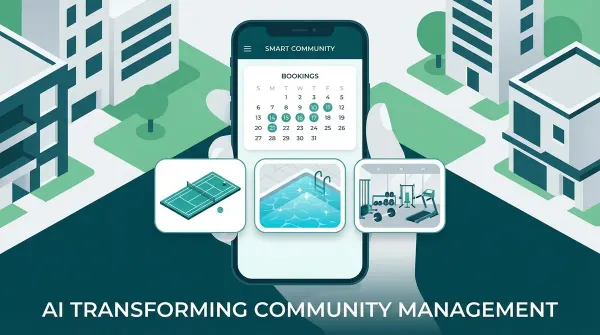
Self-service booking from the phone
The resident opens the app, sees the free slots and books. No phone calls, no waiting for confirmation, nobody writing anything down. If a booking needs manual approval from a person, the system has failed — you have just invented a new chore for the president.
Configurable rules the system enforces by itself
This is where fairness is won or lost. Look for per-facility control over:
- Slot length, opening hours and days the facility is unavailable.
- How far in advance a slot can be booked.
- A quota per property: how many active or weekly bookings each home can hold.
- No-show penalties or blocks, if the association votes for them.
- Maximum simultaneous capacity.
Written once, those rules take the allocation out of anyone’s personal judgement. That is exactly the approach behind our community space booking system.
Capacity and time slots for the pool and the gym
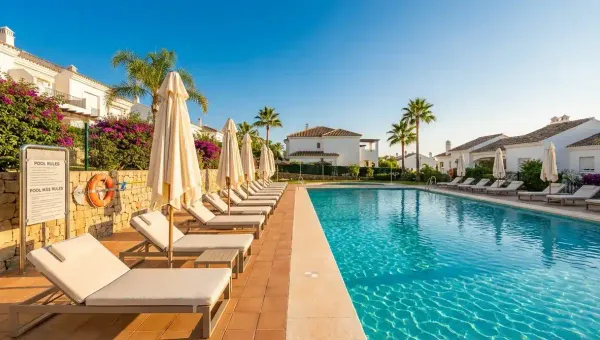
Spanish health regulations require community pools to respect a maximum capacity, and a community gym has an obvious physical limit. A slot system with capacity control does two things at once: it shares out usage and it leaves evidence that the limit is being respected.
Door opening tied to the booking
This is the feature that changes the experience most and the one fewest associations ask about first. When access to the facility is connected to the booking, the resident arrives on time and opens the door with their phone; outside their slot, they simply do not get in. Copied keys, lost fobs and special assessments to change the lock all disappear.
Payments for chargeable spaces
If the association charges for the function room or takes a deposit on the barbecue area, the resident should be able to pay at the moment of booking. Otherwise somebody has to chase the transfer — and that somebody is always the same person.
Records and traceability
Who booked, when they came in, what the capacity was each day. This is not surveillance: it is the objective evidence that settles a complaint in thirty seconds, and the documentary backup if a health inspector shows up.
A real onboarding plan
Ask who loads the register of properties, who configures the rules and how residents get their accounts. An excellent tool with a rollout that lands on the property manager’s desk is, in practice, an expensive tool.
Pricing models in the Spanish market
Three ways of charging coexist in Spain:
| Model | How it is calculated | Who it usually suits |
|---|---|---|
| Annual fee per community | A fixed yearly price, sometimes in bands by number of properties | Medium and large communities: cost per home drops sharply |
| Price per dwelling | An amount per property per month or per year | Very small communities |
| Base plus modules | A base fee with add-ons (payments, home automation, access) | Communities that only need part of the offering |
Colindar uses the first model with add-ons: the Basic plan is €163/year for communities of up to 50 properties, and the Complete plan is €260/year. The payments add-on is €132/year and home automation starts at €460/year per controller plus hardware. No lock-in contract.
One practical note about the rest of the market: not every vendor publishes its rates. As of 8 September 2026, on their official websites, Onzane, Fincapp, TusVecinos and PlusVecinos publish prices; Tucomunidad and Gestiona+ do not, and direct visitors to an enquiry or a demo. Neither approach is better in itself, but it affects your timeline: if the price is not public, you need a meeting before you can take a figure to the owners’ meeting.
Five expensive mistakes
- Choosing on feature count. The community will use four or five of them. The other forty just clutter the menu.
- Buying a management suite expecting it to solve bookings. The module exists, but it tends to be rigid on quotas and capacity — precisely where conflicts start.
- Forgetting the resident who is not comfortable with technology. If the neighbour on the fourth floor cannot book unaided, bookings go back to paper. Check there is web access as well as an app, and that the flow takes three taps.
- Not asking who does the setup. See the previous point about rollouts that end up on the property manager’s desk.
- Signing a long lock-in. In 2026 there is no need. If a vendor insists on two years, ask why.
How to trial it safely before the owners’ meeting
The sequence that works best:
- Test the tool before you propose it. Colindar offers a 15-day free trial with no card details required — enough time to configure the court and the pool and see how it behaves.
- Show the app to five residents of different profiles. If all five book on the first try, you have your answer.
- Take a closed per-home, per-year figure to the meeting, not a global price. In a 60-home community, €260/year is a little over €4 per home per year.
- Vote the rules alongside the tool. The per-home quota and the booking window are decisions for the association, not for the vendor.
If your community is still at the “which app do we pick” stage, our guide on how to choose the best app for your homeowners association is a good starting point.
What each person gets out of it
The benefits are worth separating by role, because they are not the same:
- The resident books whenever they want, sees real availability and knows the rules apply equally to everyone. With access integration, they also get into the facility with their phone.
- The president stops refereeing. The rules are approved once by the owners’ meeting and the system applies them without further intervention.
- The property manager takes on no new task at all. No writing down bookings, no mediating disputes, no chasing function room payments. The office gains quiet, not workload.
That last point is the one we get asked about most, and the one that matters most: a well-chosen booking tool does not add work to the management office; it removes phone calls from it.
FAQ
Does it make sense for a small community of 20 or 30 homes? Yes, as long as there is at least one facility with real demand. Disputes over the court or the barbecue area appear regardless of size, and the annual cost spread across the homes is very low.
What about residents without a smartphone? Look for a solution with web access from a computer and the option for a relative or the concierge to record a booking in the owner’s name in specific cases. The key is that this stays the exception, not the system.
Do we need an owners’ meeting resolution to sign up? As a general rule yes, since it is a service paid from community funds. Take the annual cost per home and the proposed usage rules as a single item on the agenda.
Can it replace the community WhatsApp group? For bookings, yes — and with an advantage: it keeps a record and enforces rules. The group can carry on for social matters, but it stops being the place where people fight over the court.
How long does it take to go live? It depends on the number of facilities and on loading the property register, but a standard community can be up and running within the 15-day trial period.
Start by trying it
Colindar has been doing this for over 10 years: more than 500 active communities, more than 30,000 residents using the app and more than 500,000 bookings handled. You can see the plans and activate the trial on the pricing page. Try the free demo: 15 days, no card details, no lock-in.
Third-party information verified on their official websites on 8 September 2026.