
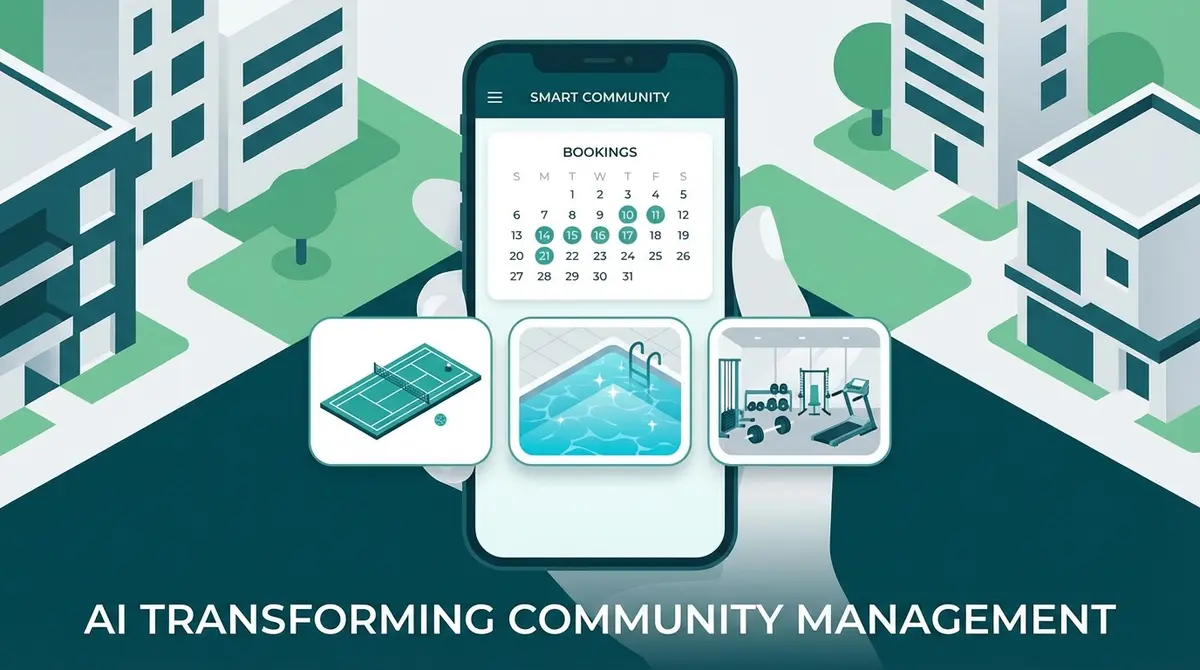
AI in Homeowners Associations: Smart Booking Management 2026
Imagine opening your phone on a Saturday morning, and instead of finding the usual calendar full of blocked slots and WhatsApp messages asking “is the padel court free at 11?”, the app itself suggests the best time for you to play, taking into account your preferences, historical occupancy, and even the weather. This is not science fiction — it is what artificial intelligence is already beginning to make possible in homeowners associations across Spain. And not just for bookings, but to completely transform the way community life is managed — from building maintenance to communication with your property manager. In this guide, we explain how it works, what practical applications it has today, and what you can expect in the coming years.
Artificial intelligence arrives in Spanish homeowners associations
The management of homeowners associations in Spain has changed more in the last five years than in the previous three decades. What used to be handled with bulletin boards in the lobby and Excel spreadsheets shared by email is now managed with specialized applications that centralize bookings, issues, and communication. But the next wave of transformation is already here, and it is driven by artificial intelligence.
From paper to algorithm: why now and not before
For a long time, talking about AI in community management would have sounded disproportionate. Homeowners associations are not large corporations with innovation departments — they are groups of families sharing a building who need to agree on how to maintain it. However, three factors have converged to make this the right moment.
First, the cost of technology has dropped dramatically. The Large Language Models (LLMs) that just three years ago were only within reach of major tech companies are now integrated into any SaaS platform at a reasonable cost. Second, the digitalization of the property management sector has reached critical mass — enough communities are using digital tools to generate the data that AI needs. And third, you are already used to Netflix recommending shows or Google Maps suggesting alternative routes. You expect that same intelligence in every service you use.
What AI applied to community management actually is (without the hype)
It is worth clarifying what we mean by AI in this context, because the term has become a label that many companies slap on any product. When we talk about AI applied to communities, we are referring to systems that analyze data — booking histories, usage patterns, incidents, energy consumption — and extract conclusions, predictions, or recommendations without a person having to perform that analysis manually.
This includes techniques such as machine learning, which allows the system to improve its predictions as it accumulates more data; Natural Language Processing (NLP), which is what makes it possible for a chatbot to understand a resident’s question written in everyday language; and computer vision, which can count people in a pool or detect the condition of a facility from images.
What AI is not, at least today, is a magical system that makes complex decisions on its own. It still needs quality data, human oversight, and clear rules defined by the community. But as a support tool, its potential is enormous.
5 practical applications of AI in community management
Let us set the theory aside and look at what AI can do today, or in the very near future, for your community. These are the five areas where the impact is clearest and most tangible.
Smart common area bookings: beyond the calendar
The traditional booking system is, at its core, a shared calendar: you pick an available slot, block it, and that is it. It works, but it is not intelligent. It does not take into account that you always book at the same time, that Saturday mornings the court has 95% occupancy, or that Monday afternoon you would be alone and could enjoy more time. The evolution of booking management systems has been pointing in this direction for years, and AI is the missing piece.
A booking system with AI can suggest alternative time slots based on your usage patterns, automatically redistribute bookings when someone cancels, and prioritize fairness so that no single resident monopolizes the best time slots. All without manual intervention.
Predictive maintenance: getting ahead of breakdowns
Every community knows what it costs to repair a breakdown — not just the financial expense, but the inconvenience and unexpected special assessments. The most common breakdowns in a community — dampness, elevator problems, boilers, pipes — follow patterns that AI can detect before the problem becomes visible.
Predictive maintenance analyzes data from sensors (temperature, humidity, vibration, electrical consumption) and compares them with historical patterns. When it detects an anomaly — for example, that the elevator motor is consuming 15% more energy than usual — it generates an alert before the breakdown occurs. In buildings with integrated home automation, this capability is already a reality.
Automated communication with residents and property managers
One of the biggest headaches for any property manager is communication with residents: answering repetitive questions, sending circulars, reminding about payment deadlines, managing issues. AI, and particularly chatbots based on Natural Language Processing, can take on a significant portion of this workload.
We are not talking about the rudimentary chatbots of a few years ago, which only answered predefined questions. Modern chatbots applied to property management understand questions phrased naturally (“when is the next general meeting?” or “I want to report a leak in the garage”), access the community’s information in real time, and escalate to a human property manager when the query requires it.
Conflict prevention and fair use of facilities
Conflicts over the use of common areas are the number one source of neighborly tension in Spain. And in most cases, the root of the problem is the same: lack of transparency and a feeling that the allocation is not fair. AI can help prevent these in several ways.
On one hand, by analyzing booking data to detect hoarding patterns — for example, that a group of residents systematically books the best padel court time slots — and suggesting rule adjustments. On the other hand, by establishing dynamic usage quotas: if the pool is the most in-demand resource during summer, the system can automatically apply stricter time limits. Pool capacity control is a perfect example of how technology is already helping make usage fairer.
Energy optimization and cost reduction
The energy bill is one of the most significant budget items for any community. And it is also one of the easiest to optimize with AI. Intelligent systems can analyze the building’s consumption patterns — common area lighting, central heating, pool climate control — and automatically adjust them based on actual occupancy and external conditions.
If the system knows that no one has booked the gym between 2:00 PM and 5:00 PM, it can reduce lighting and climate control. If it detects that automatic lighting is activating when there is already sufficient natural light, it can recalibrate. According to industry studies, energy optimization with AI can reduce common area consumption by between 15% and 30%, a significant saving for the community.
How AI transforms the experience of booking common areas
Of all the applications we have discussed, booking management is probably the one that will most change the everyday resident’s experience. Let us see how.
Personalized time slot and space recommendations
Just as Spotify learns what music you like, a booking system with AI can learn your preferences and anticipate them. If you book the padel court every Wednesday at 7:00 PM, it would not make sense for you to open the app every week, search for the slot, and confirm it. The system can propose the booking automatically and simply ask for your confirmation.
If your usual time slot is taken, instead of showing an error, it can suggest alternatives based on your history and actual availability. And if there are several similar spaces — two padel courts or multiple multipurpose rooms — it can recommend the one that best suits your needs.
Usage pattern detection and automatic redistribution
One of the most common problems in court and gym shift management is uneven demand distribution: everyone wants the same time slots and the rest of the time the facilities sit empty. AI can analyze these patterns and propose — or automatically apply — redistribution measures.
For example, it can identify that on Tuesdays between 10:00 AM and 12:00 PM there is latent demand (residents who could not find a slot at other times) and send them a notification suggesting that alternative. Or it can apply rotating shifts for the highest-demand time slots, ensuring that all residents have equal opportunities.
Managing conflicts from overuse: when AI arbitrates
When a resident feels they always miss out on a slot to book the padel court, conflict is inevitable. AI can act as an impartial referee, applying fairness rules defined by the community itself. If the board has decided that each owner can book a maximum of two hours of court time per week, the system enforces it automatically, without exceptions or favoritism.
But AI can go beyond fixed rules. It can detect situations of inequality — for example, a resident who books every week but cancels at the last minute, preventing others from taking the slot — and propose regulation adjustments. This information is extremely valuable for the board when making informed decisions.
From smartphone to door: booking, access, and smart activation
The ideal experience requires no effort: you book from your phone and, upon arrival, the door opens, the lights turn on, and the system logs your access. No keys, no codes, no cards. Automatic door opening linked to bookings is already a reality in many communities, and AI adds an additional layer of intelligence.
If the system detects that you have arrived five minutes early and the court is free, it can grant you early access. If you have not arrived fifteen minutes after your booking, it can release the slot for another resident to use. Combined with the various ways to access facilities — Bluetooth, QR, NFC, facial recognition — the experience is completely seamless.
AI for property managers: from assistant to strategic ally
AI does not only benefit residents. For property managers, it can be the difference between surviving and thriving in an increasingly competitive sector.
Automating repetitive tasks: issues, minutes, and circulars
An average property manager handles between 30 and 60 communities. That means hundreds of monthly issues, dozens of meeting minutes, circulars, and a constant flow of resident inquiries. Most of these tasks are repetitive and consume a disproportionate amount of time.
AI can automate the classification and prioritization of issues (separating urgent ones from routine ones), generate draft minutes from meeting recordings, and write personalized circulars. The property manager goes from being a task handler to a professional who makes strategic decisions, spending more time on the relationship with owners and the improvement of the communities they manage.
Data analysis for board meeting decisions
Every community generates valuable data: spending history, energy consumption, breakdown frequency, facility usage, delinquency rates. The problem is that this data is rarely analyzed systematically. AI can turn it into clear, actionable reports to present at board meetings.
Imagine arriving at a meeting with a report that says: “Pool usage has grown by 23%. If we maintain the same maintenance investment, the risk of a filtration system breakdown increases by 40%. Recommendation: allocate an additional 2,000 euros for preventive maintenance.” That is what a good property management software powered by AI can offer.
The community chatbot in 2026: nothing like the one from 2018
Chatbots have come a long way. In 2018, a community chatbot was little more than an interactive FAQ: it answered predefined questions and, faced with any variation, it froze. In 2026, thanks to the latest generation of language models, a community chatbot can hold natural conversations, access the community’s database, and resolve complex queries.
A resident can type “I want to book the social room for my son’s birthday next Saturday” and the chatbot can check availability, make the booking, send a confirmation, and remind them of the usage rules. All without human intervention. And if the query requires the property manager — for example, a formal complaint — the chatbot escalates it with all the necessary context.
What to look for when choosing community management tools with AI
Not all tools marketed as “intelligent” truly are. If your community is evaluating a community management platform with AI, these are the key criteria.
Real integration vs. marketing label
The first filter is distinguishing between tools that genuinely use AI and those that simply include the term in their advertising. A tool with real AI should be able to show you how it learns from your community’s data, what predictions it generates, and how they improve over time. If the “artificial intelligence” is limited to basic automations that could be done with simple rules, it is not AI — it is marketing.
Ask providers: “What models do you use?”, “How do you train the system with each community’s data?”, “How do you measure the accuracy of the recommendations?”. The answers will give you a clear idea of whether you are looking at a genuine solution or a fancy wrapper.
Privacy and data protection (GDPR) in AI tools
This point is critical. Any AI tool that handles resident data — names, usage schedules, behavior patterns, camera images — is subject to the General Data Protection Regulation (GDPR). Penalties for non-compliance can reach 20 million euros or 4% of annual turnover.
Before adopting any AI tool, make sure it complies with the GDPR, that data is processed within the European Union, that there is a clear legal basis for the processing, and that residents are informed about what data is collected and how to exercise their rights. AI should never be implemented at the expense of privacy.
Ease of use: if residents do not use it, it is useless
The best technology in the world is useless if residents do not adopt it. And in a community, the profiles are very diverse: from young digital natives to elderly people who barely use their smartphones. The tool you choose must be accessible to everyone.
This means a simple interface, hassle-free setup, clear notifications, and the ability to perform basic operations — such as booking a community space — in three clicks or fewer. AI should work in the background, improving the experience without adding complexity. If a resident needs a computer science degree to take advantage of it, something has gone wrong.
The near future: what to expect in 2026-2028
The proptech sector evolves at a dizzying pace. These are the trends we will see consolidate in the coming years.
Digital twins of the building and the Digital Building Logbook
The concept of a digital twin — a virtual replica of the building that reflects its state in real time — is moving from the industrial sector to real estate management. In Spain, the push for the Digital Building Logbook (Libro del Edificio Digital) by the public administration is accelerating this trend. A digital twin allows you to simulate the impact of a renovation before carrying it out, predict when each installation will need maintenance, and optimize the energy consumption of the entire building.
For the communities of the future, the digital twin will be a fundamental management tool. Combined with AI, it will enable decisions based on real data rather than estimates.
Community virtual assistants with local knowledge
Generalist virtual assistants will evolve into specialized versions with local knowledge. Imagine an assistant that not only knows when the next board meeting is, but also knows your community’s bylaws, the pool rules, the concierge’s schedule, and the status of open issues.
That assistant would be the single point of contact for any community-related query, drastically reducing the property manager’s workload. And unlike a control panel that you need to learn how to use, a voice or text assistant is intuitive by nature: you ask and it answers.
AI that learns from YOUR community
Perhaps the most transformative trend is personalization. Current systems apply the same rules to all communities, but each one is different: different schedules, different resident profiles, different facilities. The AI of the near future will learn from the specific behavior of your community and adapt its recommendations accordingly.
If padel court demand triples on Friday afternoons, the system will know. If the gym has a usage peak in January and drops off sharply in March, it will adjust cleaning and maintenance based on those cycles. Communities that are already using digital tools for access control and space booking are accumulating the data capital that will make that personalization possible. Each community will have its own “intelligence” adapted to its reality.
Colindar and artificial intelligence: building the future of community bookings
At Colindar, we have been working for years to make managing your community’s common areas as simple as ordering food delivery. And now we are taking it a step further: integrating artificial intelligence into our platform so that bookings are not just easy, but truly intelligent.
We cannot share all the details yet — there are features we are prototyping and testing with pilot communities — but we can tell you where we are heading: a system that learns from your community’s usage patterns, suggests optimal time slots, detects conflicts before they happen, and connects each booking with door opening, light activation, and capacity control.
In the meantime, today you can already enjoy:
- Community space booking with shared calendar and automatic notifications
- Court and gym management with shifts and integrated access control
- Automatic door opening linked to your bookings
- Pool capacity control in real time
- Padel court booking from your smartphone
Try the free demo and discover what you can already do today. The future of your community starts now.